
Table of Contents
There is no legal age limit that stops you from becoming a professional soccer player. What exists instead are ages when the game looks at you on its own, and ages when nobody looks unless you make them. That is the real distinction, and almost nobody explains it.
It is also why how old you have to be to play professional soccer has no single answer: ten and seventeen are not the same question. This article goes age band by age band, says what is still open at each one, and covers what to do when no club has come looking — which is the situation of nearly everyone who searches for this.
How old do you have to be to play professional soccer?
- 8 to 12 — nothing to chase. If you play for a club and stand out, you get seen. The job of these years is not to be scouted; it is to still want to play at fifteen.
- 13 to 16 — when academies and development programs look seriously, and when most selections happen. Also the hardest stage to enter from outside.
- 16 and up — old enough for a first professional contract. And if you are not already inside a development system, nobody is coming to find you.
- 17 to 23 — the door is still open, but you have to open it. That is the second half of this article.
Worth saying early: none of these ages tells you anything about your level. They tell you when the system looks, and through which door. Those are different things, and confusing them does real damage.

8 to 12: the age when they see you without you trying
At this age no special effort is required. A kid who stands out on his team gets noticed: coaches talk to each other, clubs follow the competitions in their area, and development programs have people watching youth soccer. Playing regularly, on a team that competes, is all the exposure needed.
What is worth understanding is that at ten, nobody knows who is going to make it. Bodies change at very different rates between eleven and fifteen, and the most advanced player in an age group is often, simply, the one born in January. It is a known and measured effect: players born early in the year are over-represented in academies, and not because they have more talent.
The practical conclusion for a parent is reassuring: nothing is being decided at this age. The only thing you can lose here is the appetite.
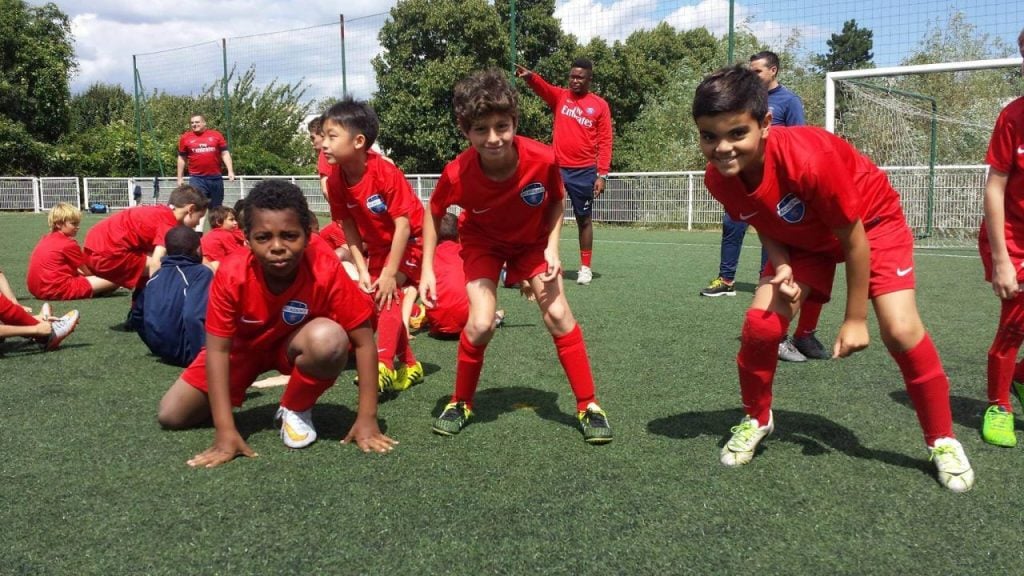
Which is why what works best in this band is not training more, but playing somewhere different. A week at a summer soccer camp alongside kids from twenty countries does two things at once: it shows a child that soccer is bigger than the local league, and it sends them back in September with their enthusiasm intact. At ten, that is worth more than any career plan.
13 to 16: why getting in depends on where you play
This is where most of it is decided. Clubs fill out their youth groups, and from sixteen a player can sign a first professional contract. If you are going to enter a professional development system, this is normally when it happens.
And here is the part almost nobody says out loud: getting in depends as much on where you play as on how you play. A club mostly watches the games it has nearby and the competitions it travels to. A player of the same level in a smaller market, in a league nobody visits, simply does not appear on anyone’s radar.
So if you are reading this at fifteen and have never been inside a development program, the correct reading is not “I’m not good enough.” It is “I wasn’t where they were looking.” Those are very different, and the second one has a solution.
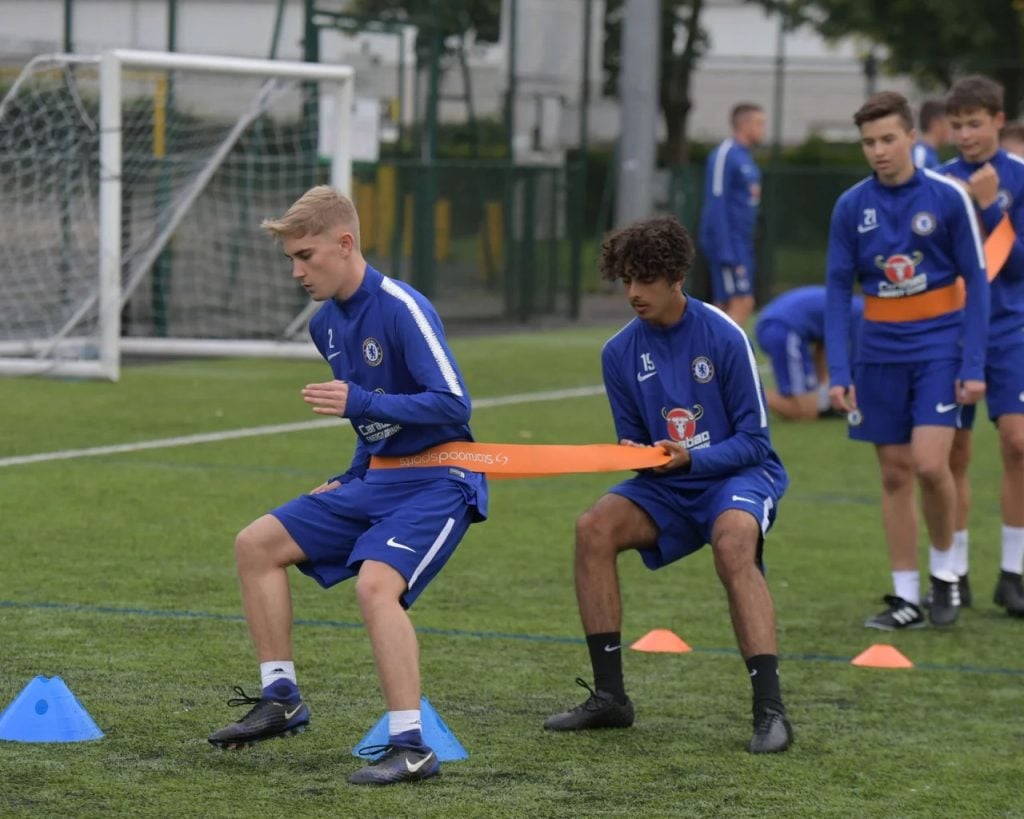
There is also an advantage most families never use: the off-season is long. Those are weeks in which the player inside an academy keeps working and the one outside stops. A few weeks at a high-performance soccer academy in England changes that, and not only through training hours: you play against a different style, work with coaches who ask for different things, and compete with players brought up in another school of the game. Adapting to exactly that is what a trial tests.
“My son wants to be a professional soccer player”: what to do
It is one of the most common things families write to us, and behind it is nearly always the same double fear: holding back a kid who might have something, or letting them chase something that will not arrive. Both worries are reasonable. What actually helps:
- Get an outside evaluation, not one more opinion. Their club coach has known them for three years and is fond of them. Someone who does not know them will say something more useful, even if it stings.
- Set a deadline, not a dream. “This season we find out seriously where he stands” is manageable. “He is going to be a professional” is not.
- Do not touch the schoolwork. For the reason explained further down: it is not a plan B, it is part of the profile.
- Distrust anything that promises. A contract cannot be promised. Being watched by scouts can.
- Never pay for a signature. If someone asks for money in exchange for a club signing your child, that is the clearest sign you are not dealing with serious people. No club charges to sign a player.
If you are in the US or Canada: the route to Europe
Most people reading this are in the United States or Canada, and the situation there is genuinely different from Europe’s. College soccer is a real and valuable path, and for many players it is the right one — it keeps the education and the game together for four more years.
But if the goal is European professional soccer, the obstacle is rarely level. It is distance. European club scouts do not cross the Atlantic to watch a youth league, and a player cannot show up there for a weekend. Add the part nobody mentions on the forums: flights, accommodation and paperwork.
Put another way: for a North American player, the problem to solve is not “get better”, it is “be in front of someone who decides”. And unlike talent, that can be arranged.
Getting seen: the open tryout
From sixteen or seventeen onwards, “how to become a professional soccer player” reduces to one practical question: how do I get a scout to watch me play? Everything else — the fitness, the video, the nutrition, the hours — serves that moment. Without it, nothing happens.
There are several ways to get there. Move up a level and hope someone passes through. Play an international tournament clubs send someone to. Have a coach with contacts. All three work, and all three share a problem: you do not choose the date.
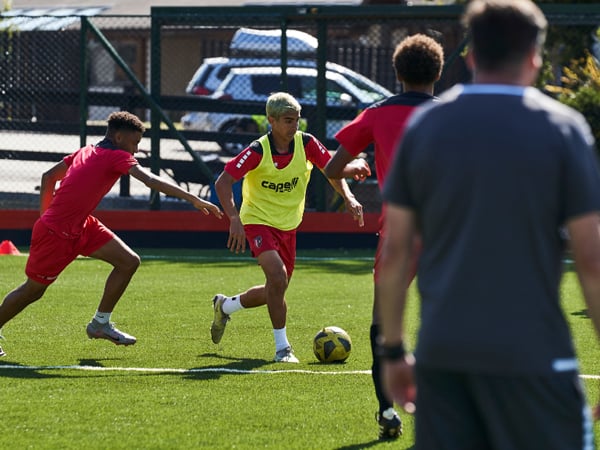
An open tryout inverts that. Instead of waiting for a scout to pass through where you play, you go where the scouts are, because they were invited. Players train and compete for several days under professional coaches while club scouts watch and take notes — every day, not just on the final match day. That is what our soccer tryouts are.
The format changes depending on where you want to be seen: football trials in Spain put you in front of Spanish professional clubs, while the tryout at the high-performance academy in England looks to British football. The choice depends less on your level than on the league you picture yourself in.
Signed or not, there is something you take home: an individual written report on your game, from someone who does this for a living. A player who goes home with that document finally knows where they stand — which is more than most have.
Do you have to pay for a soccer tryout?
It is everyone’s first question and it deserves a straight answer rather than a dodge.
Two different things get confused here. An invitational trial is what a club runs for a player it has already seen and likes: the player pays nothing, but decides nothing either, because they had to be discovered first. An open tryout is the opposite: anyone can enter, and it has a cost, because it takes facilities, a professional coaching staff, accommodation, and club scouts present for several days.
Put as honestly as possible: you are not paying for a scout’s decision, you are paying for the week that puts you in front of one. And if you are selected, the trial that follows at the club costs you nothing. Free exists in this business — it is at the end of the road, not at the entrance.
With that clear, be wary of two things: anyone charging for a signature, and sites presenting themselves as a famous club’s official recruitment channel. That is not how it works.
What if what is missing is time, not a week?
A tryout lasts a few days. If what you need is to improve across a whole season without stopping your education, you are not looking for a tryout — you are looking for a year-round academy: daily high-level training, school alongside it, and enough time to close a technical or physical gap.
It is usually the better answer for a sixteen- or seventeen-year-old with the potential but not yet the level, and it is the only route that does not ask a family to bet a child’s education on soccer. You can see how our high-performance soccer academies work.
School does not compete with soccer: it is part of it
Many families experience school and soccer as two things fighting over the same hours. Clubs do not see it that way. Academies are required to keep their players in education, and when a professional club explains publicly how it selects, it usually names three things together: athletic performance, academic record and personal qualities.
In other words: a player’s schoolwork does not compete with their tryout, it is part of it. A kid who is serious in class is, to a scout, a kid who will be serious in training. And it is the only part of all this that still counts if the soccer does not happen.
What no tryout can promise you
No tryout, whoever runs it, guarantees a contract. Anyone telling you otherwise is lying, and that is the most reliable signal that it is time to walk away.
What it does guarantee is something else, and it is not nothing: that someone who does this for a living will have watched you play for several days running and written down what they think. From sixteen onwards, when nobody comes looking any more, it is the only thing you can make happen yourself.